HOLDING FORM IN A DIGITAL AGE
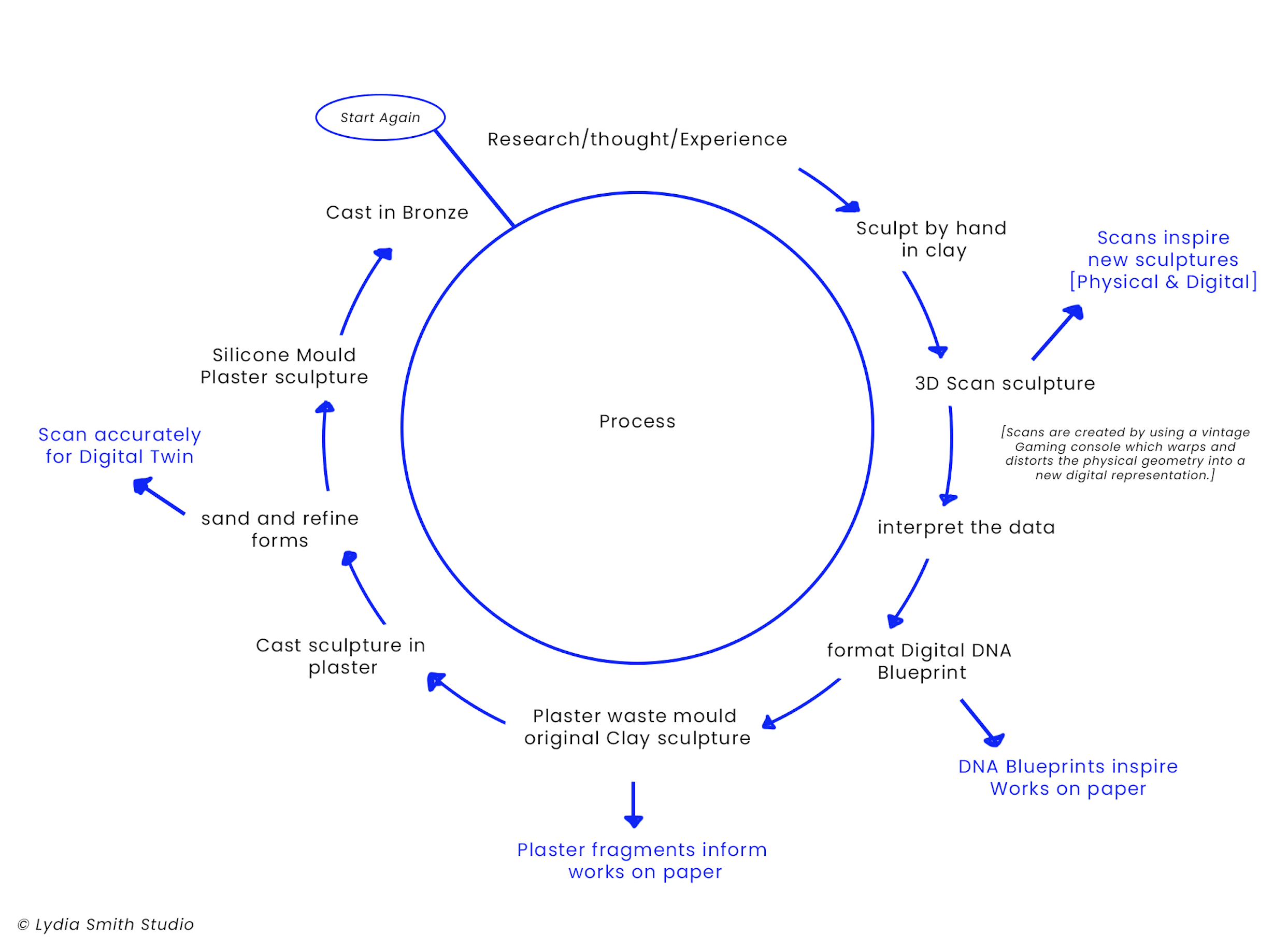
My practice begins without certainty.
I work through automatism, allowing intuition to lead before language and logic intervene. Rather than starting with fixed outcomes, I allow research, thoughts and lived experiences to surface through the act of making. This openness is essential to how I work; it creates space for the unconscious and for ideas to emerge through the material rather than be imposed upon it.
I work across sculpture, works on paper, and digital media, often moving fluidly between them. Clay, plaster, scans, code, and prints are not separate stages but interconnected states. Each informs the other. What begins as a gesture in the hand may later become data, a digital artefact, or a two-dimensional blueprint. I’m interested in this movement between forms, and in how meaning shifts as material is translated.
At the core of my practice is an ongoing inquiry into human connection. I’m drawn to the ways ancient beliefs, technological systems, scientific inquiry, and spiritual experience intersect. Across history, humans have turned to ritual, measurement, myth, and now data to map the self. I see contemporary technology not as a break from this lineage, but as another chapter within it.
From this perspective, I explore the hidden systems that shape who we are. Some of these systems are internal: subconscious conditioning, instinct, memory, and inherited behaviour. Others are external: social structures, algorithms, economic forces, and digital platforms. I’m interested in where these systems overlap, and in questioning where instinct ends and identity begins. How much of who we are is chosen, and how much is coded - biologically, culturally, or perhaps digitally?
Geometry often emerges within my work as a quiet organising force. Lines repeat, split, and reemerge across both physical and digital space. There is a dialogue between line and form, between intuition and structure. As I move from my hands to software, and back again, a language develops -one that interprets the oscillation between thought and material. The finished works often hold a sense of balance and tension, inviting a pause.
Sculpture, for me, is grounding. It anchors me in time and space when so much of our experience is mediated through screens, im able to be tactile and connect with a material that stretches back throughout human culture. You might assume that by incorporating my digital experiments, I would see them as opposing states; however, to me, they often reveal organic shapes and symbols that mirror logograms, linking me again to the natural world. I’m interested in the space between where our physical bodies coexist with digital avatars, profiles, and data traces. Sculpture becomes a way to negotiate that tension, commanding presence and observation across both tactile and virtual realms.

The Creation of the Virtual Venus, DNA Blueprint
My printed digital “DNA blueprints” that accompany each sculpture are central to my exploration. They symbolise the reality that we are no longer separate from our digital identities. Our physical and digital selves are increasingly intertwined, each shaping the other in subtle but profound ways. Online representations influence how we are perceived and how we interpret the world, while our physical experiences feed our digital chambers through our curation of images and language.
These prints also reflect a dimensional shift. As three-dimensional beings, we now perform large parts of our lives two-dimensionally - through interfaces and flattened representations. The movement of my sculptures between 3D and 2D mirrors this condition. It asks what is lost, gained, or transformed in translation, and how far this process might go in the formation of Self.
Throughout my practice, I return to questions of heritage and permanence. What do we give value to now - the physical object/identity or its digital counterpart? What endures: the material form, the data record, or experience held in memory?
My work invites viewers to consider their own position within these shifting realities, and how they show up in each space, to notice how deeply entangled our lives are with systems - seen and unseen - and to meditate on the nuance of each realm.
I hope the viewer will slow down to reflect on the structures that shape us and the quiet moments when we find ourselves. Through making, I attempt to hold complexity and contradiction in alignment - to create works that are grounded, open, and reflective of the evolving world we inhabit.