Lydia Smith’s practice begins without certainty.
Working through automatism, she allows intuition to lead before language and logic intervene. Rather than starting with fixed outcomes, she allows research, lived experience, and subconscious associations to emerge through the act of making.
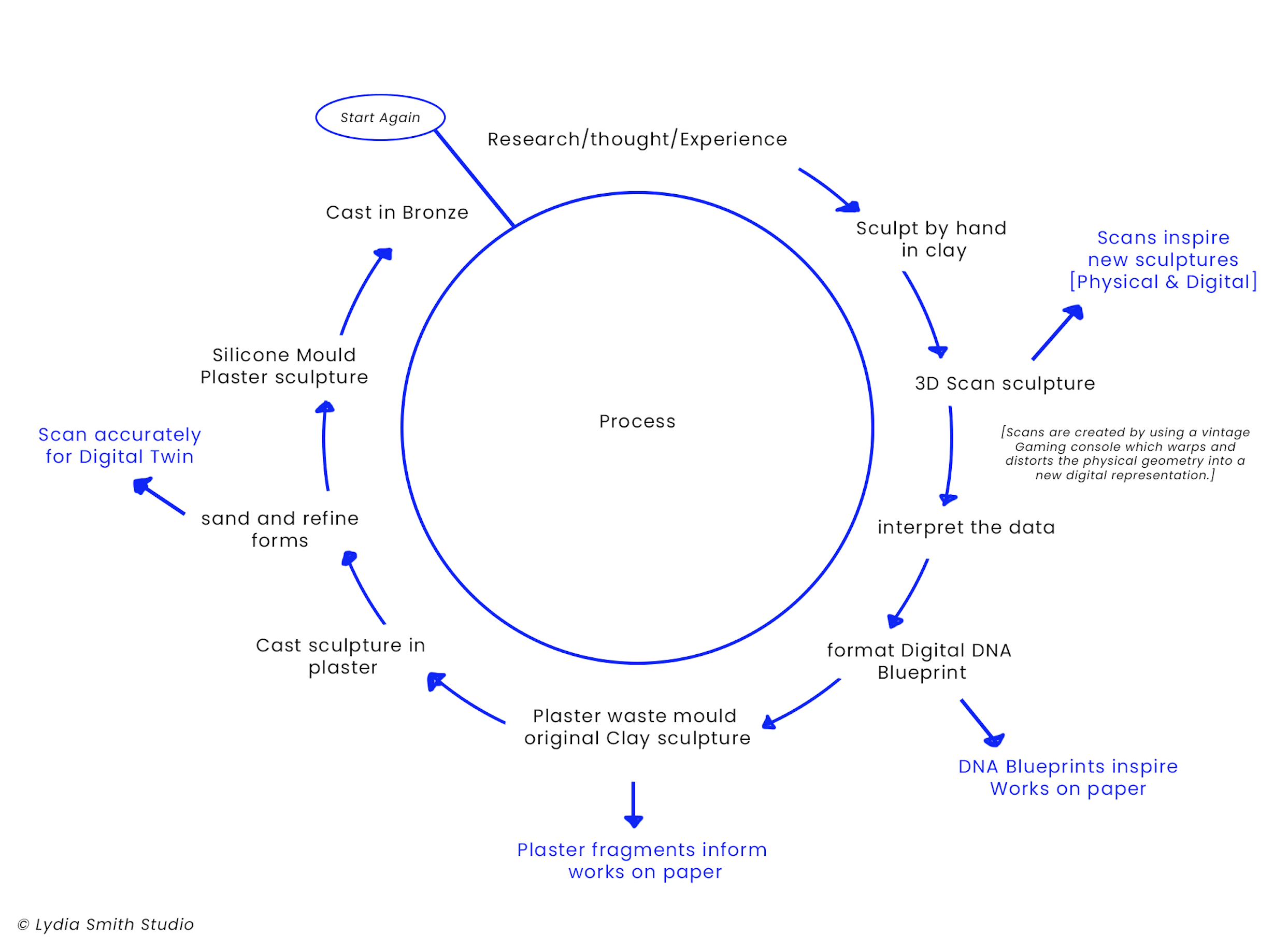
This openness creates space for ideas to surface through material rather than be imposed upon it. Working across sculpture, works on paper, and digital media, Smith moves fluidly between physical and virtual forms. Clay, plaster, bronze, scans, code, and prints are not separate stages but interconnected states. What begins as a gesture in the hand may later become data, a digital artefact, or a two-dimensional blueprint. She is interested in this movement between forms and in how meaning shifts through translation. At the core of her practice is an ongoing inquiry into human connection.
Drawing from ancient belief systems, scientific enquiry, technology, and spirituality, Smith explores how humans have sought to understand themselves across time. She sees contemporary technology not as a break from this lineage, but as another chapter within it. Her work examines the visible and invisible systems that shape identity. Some are internal: instinct, inherited behaviour, and subconscious conditioning. Others are external: social structures, economic forces, and technological networks.
Smith is interested in where these systems overlap, questioning how much of who we are is chosen and how much is coded.
Geometry is an organising force within these investigations. Lines repeat, divide, and reappear across physical and digital space, creating a dialogue between intuition and structure. As forms move between hand and software, a visual language develops that reflects the oscillation between thought and material. Sculpture remains central to Smith’s practice. It offers a tactile connection to material traditions that stretch throughout human history, grounding her within an increasingly fast-paced world.

Identity Stretch DNA Blueprint © Lydia Smith
Rather than opposing the digital, she sees these spaces as interconnected. Her digital experiments often reveal forms and symbols that echo organic structures and ancient mark-making, linking technological processes back to the ancient world. The digital DNA blueprints that accompany some of her sculptures reflect this relationship. They acknowledge that physical and digital identities are no longer separate, but increasingly intertwined.
As three-dimensional beings, we now experience much of life through two-dimensional interfaces and flattened representations. The movement of her sculptures between three and two dimensions mirrors this condition, asking what is transformed through translation. Through sculpture, drawing, and digital media, Smith explores the systems that shape us and the realities we inhabit. Ultimately, her practice returns to a central question: how much of who we are is chosen, and how much is coded?