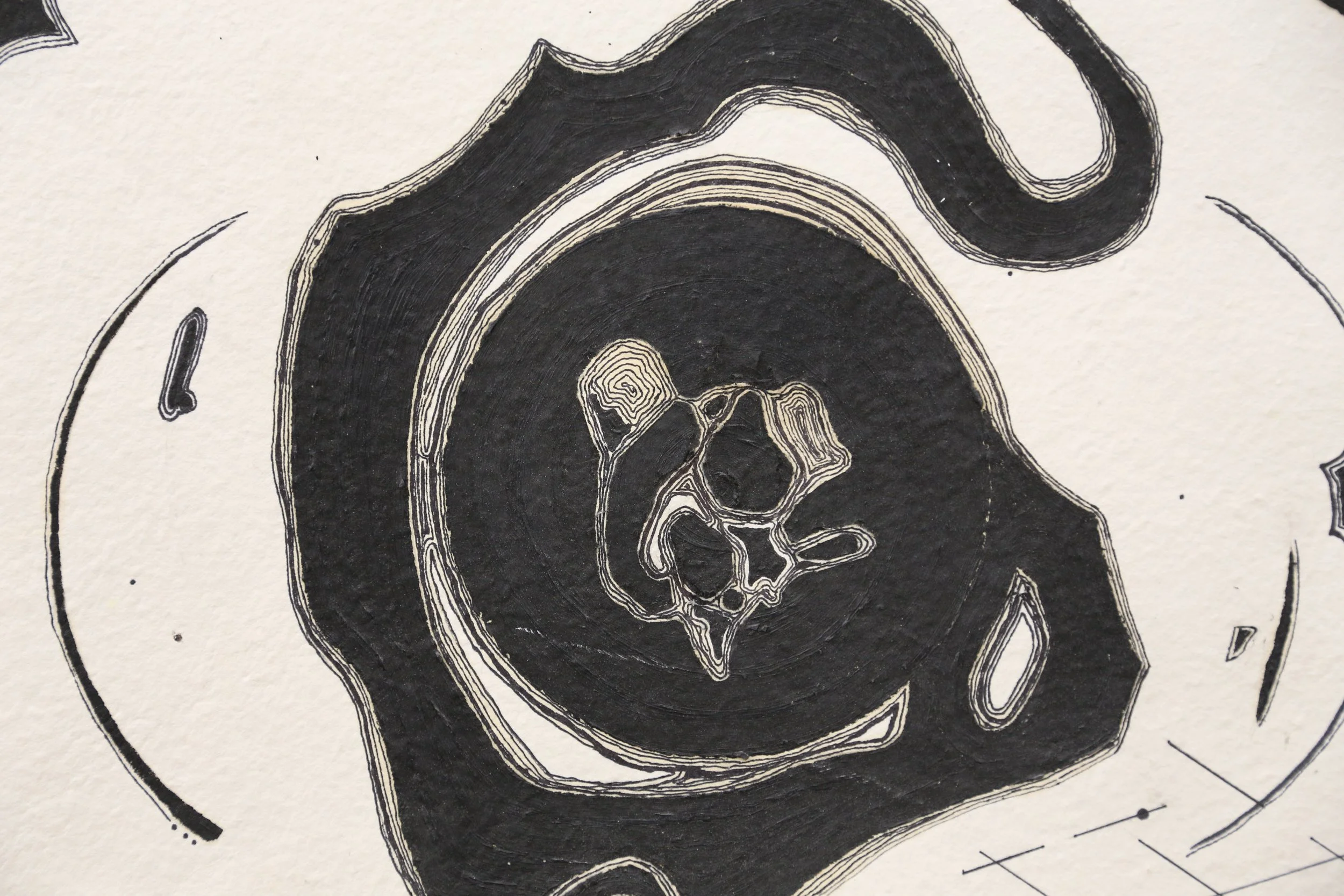
Sphere States
By Lydia Smith
© Lydia Smith
February - April 2026
Join us on March 25th, from 6-8:30 pm, to celebrate the exhibition.
27 Chiltern St, London, W1U 7PJ
Created in collaboration with Chiltern Street Deli
Sphere States explores how the public sphere is shaped through communication and how shared language can become polarised, creating division rather than unity.
Drawing on Jürgen Habermas’ theory and contemporary research on digital echo chambers, Lydia Smith reflects on how discourse and technology fragment collective experience into parallel yet interconnected worlds. Using the geometric sphere as both form and metaphor, the exhibition contrasts ideals of balance with the realities of social division.
Building on her earlier exhibition, Kaleidoscopic Loops, Smith presents spheres in both complete and distorted forms, asking whether systems that hold separation might also contain the conditions for harmony.
The exhibition presents twenty-three works on paper created by Smith since she began incorporating the medium into her practice in 2022.
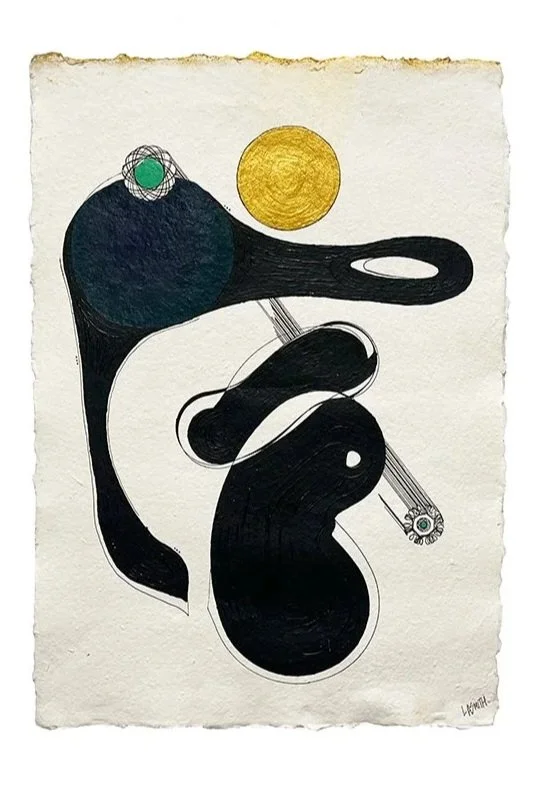
Geography, 2025, Unique
Acrylic, ink, gold pigment & lacquer on 100% cotton paper
61 x 42 cm
£245
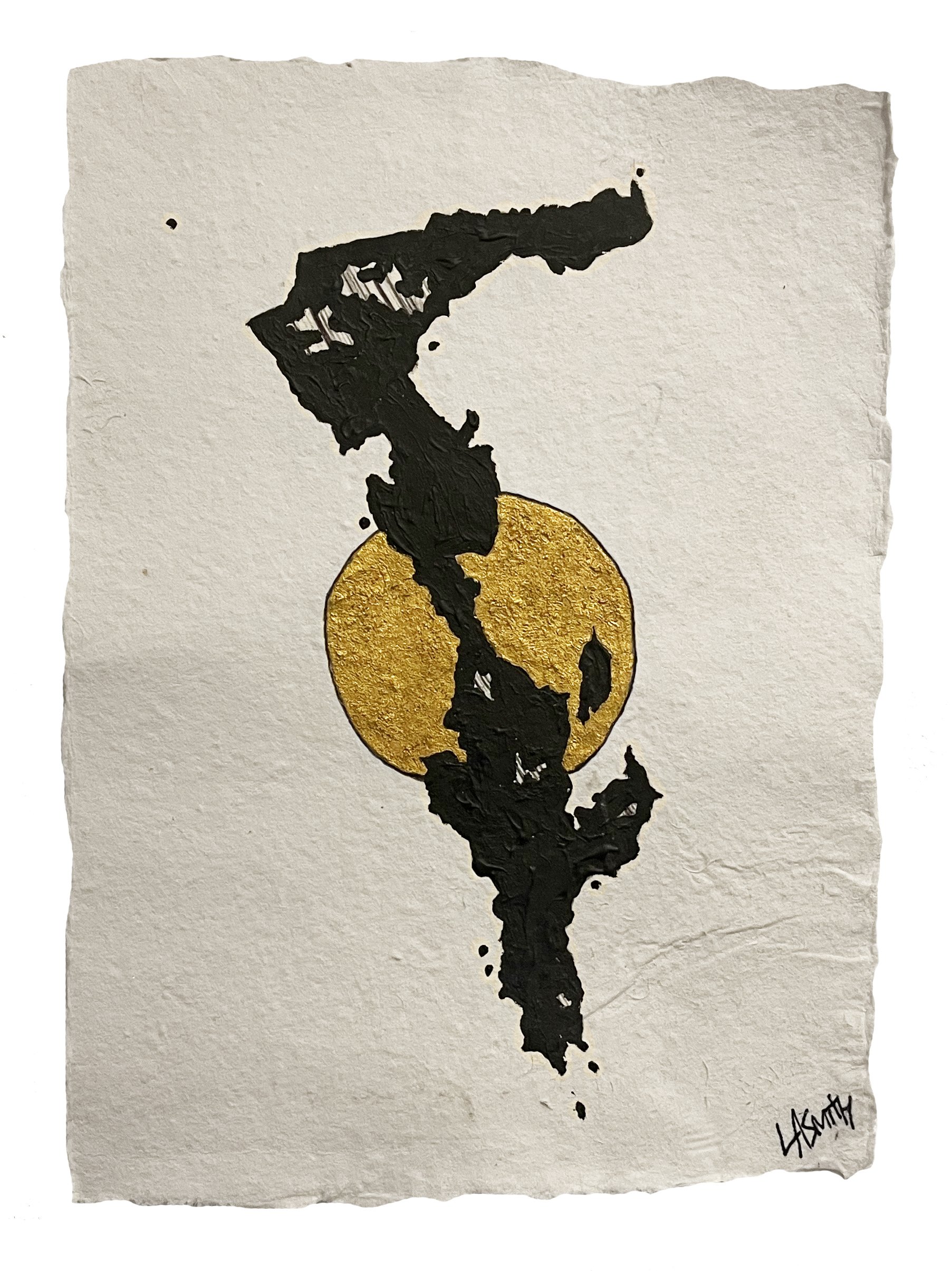
Entity 0.2, 2022, Unique edition 1/10
Acrylic, ink, gold pigment & lacquer on 100% cotton paper
30 x 22 cm
£100
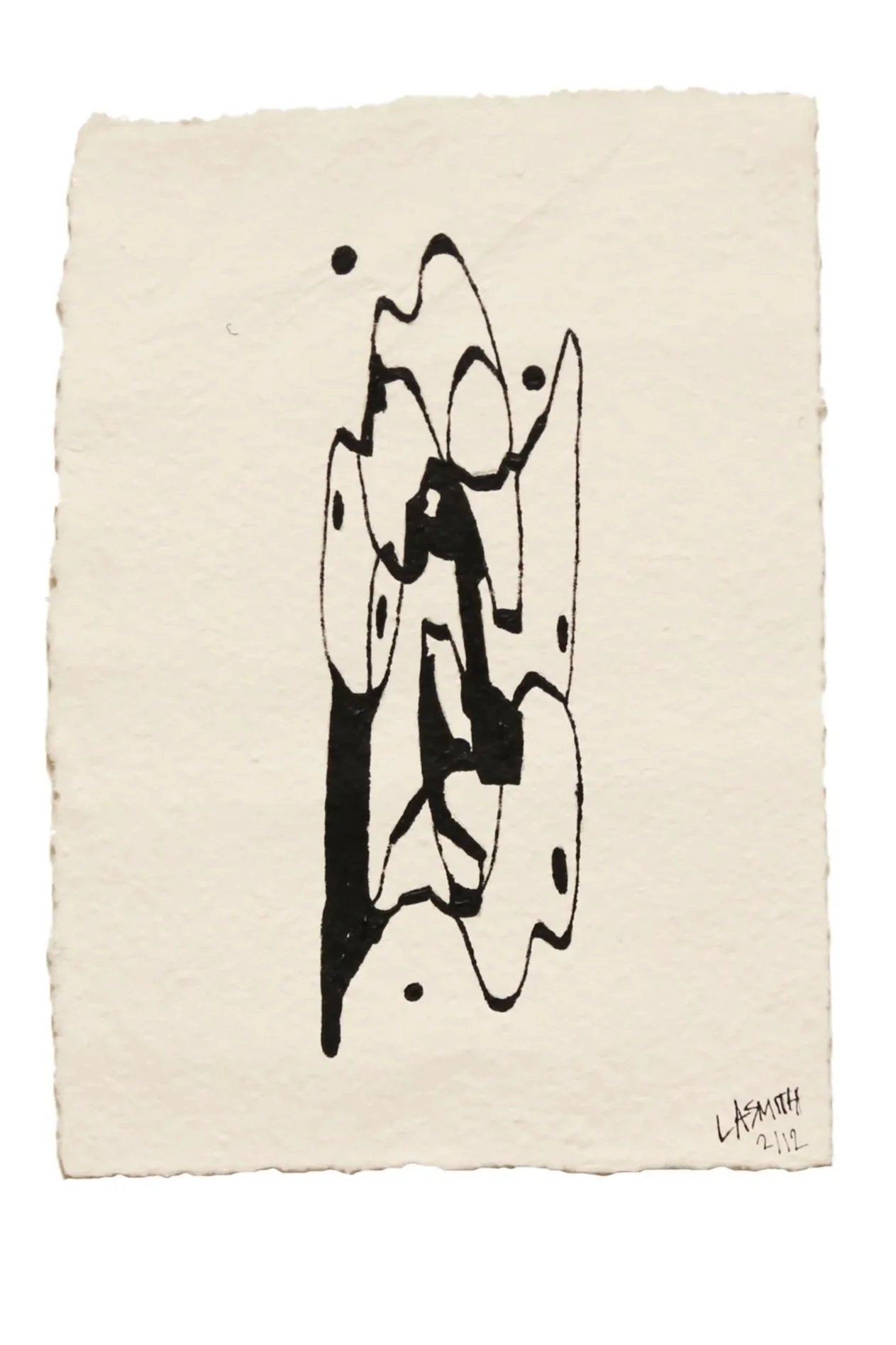
Shape Your Future, 2024,
Unique edition 3/12
Acrylic & ink on 100% cotton paper
30 x 22 cm
£85
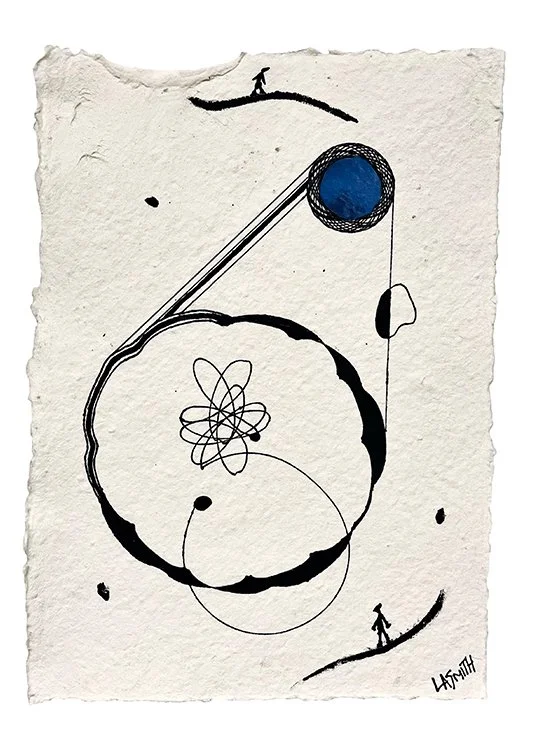
Playing with Parameters, 2025, Unique
Acrylic & ink on 100% cotton paper
30 x 22 cm
£100
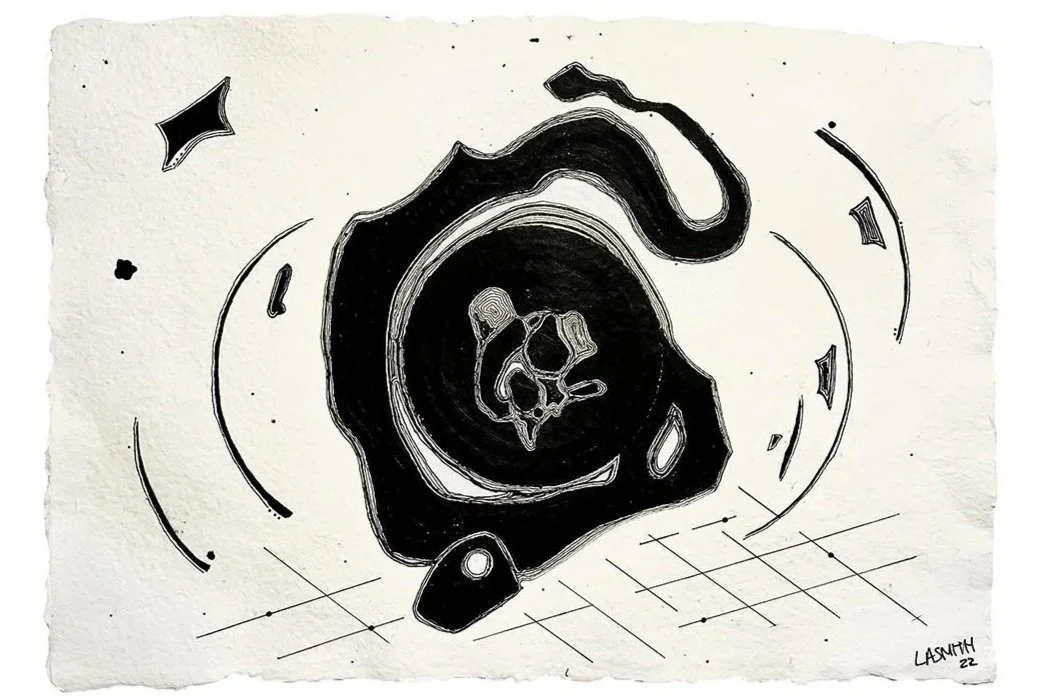
Expand, 2022, Unique
Acrylic & ink on 100% cotton paper
42 x 61 cm
£185
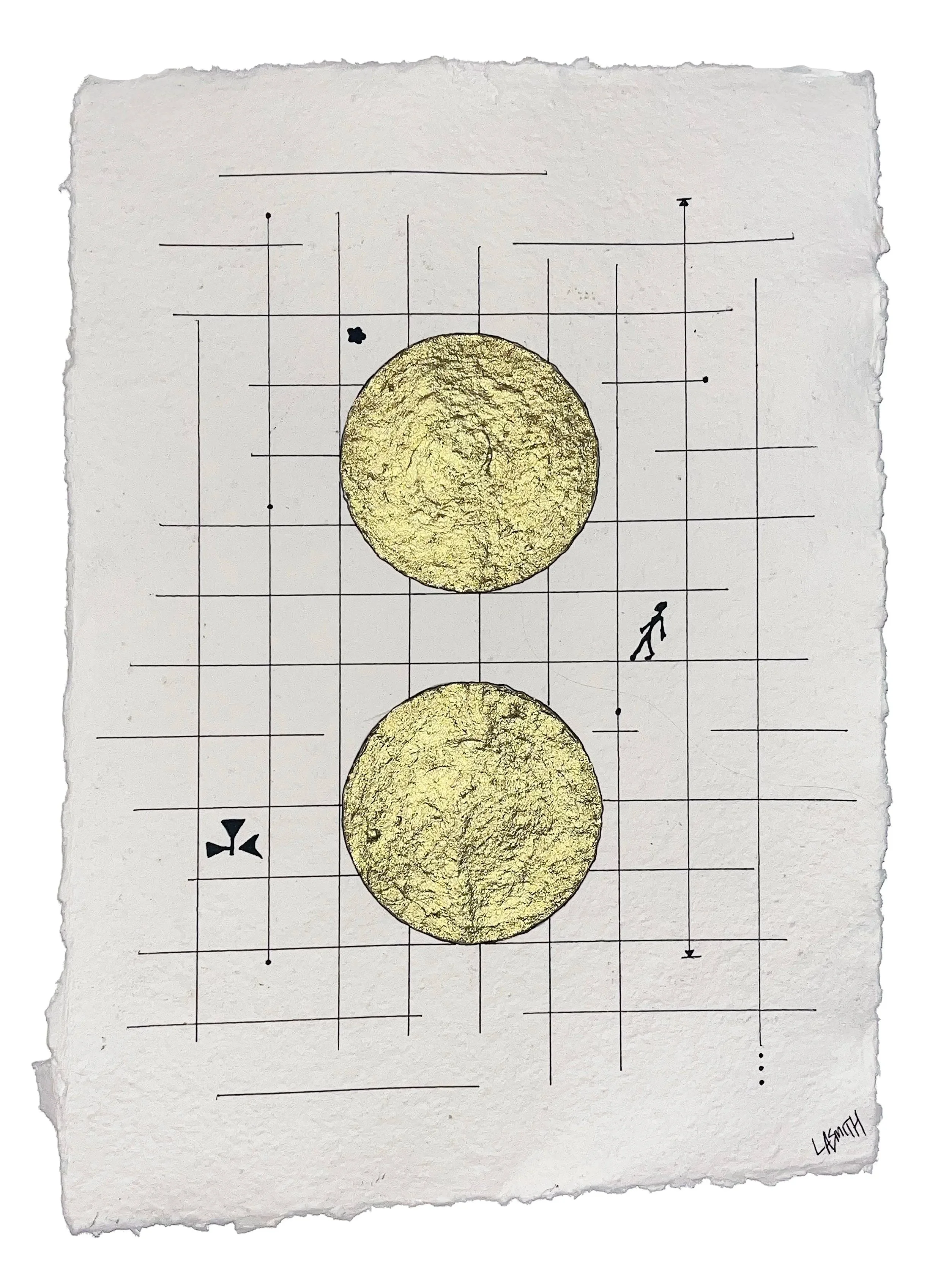
Truth & Trust, 2026, Unique
Acrylic, ink, gold pigment & lacquer on 100% cotton paper
48 x 33 cm
£165
In the exhibition Sphere States, Lydia Smith considers how the public sphere is constructed through communication and how the language shared within these spheres can become polarised, often creating division across communities rather than uniting them. This exploration resonates with Jürgen Habermas’ theory of the public sphere, which describes social reality as shaped through discourse, where collective meaning emerges through communication but is also subject to fragmentation and exclusion (Habermas, 1989).
Since the rise of social media, this fragmentation has intensified, reinforcing digital echo chambers that shape perception and behaviour. Scholars argue that these echo chambers and filter bubbles contribute to the decline of democratic exchange, as personalised recommendation systems increasingly expose individuals to belief-aligned content, reducing engagement with opposing perspectives (Hartmann et al., 2025). These digitally constructed spheres increasingly extend into physical environments, producing self-contained parallel worlds that exist side-by-side yet rarely intersect.
In geometry, a sphere is a perfectly symmetrical three-dimensional form in which every point is equidistant from the centre. The sphere represents a condition of balance, where no single point holds greater importance and the whole is formed through equal relation. Yet when translated into social contexts, this ideal of unity becomes unstable. Public spheres are rarely balanced: they fragment along lines of belief and perspective, forming multiple centres rather than a single shared core. In this contrast, the sphere becomes both a symbol of unity and a contemporary marker of division, revealing how systems built from equal parts can, through differing interpretations, produce separation rather than cohesion. Throughout the exhibition, Smith places the sphere in dialogue with contrasting lines and forms, symbolising how diverse opinions can live in harmony both on and off the paper.
Sphere States builds on Smith’s solo exhibition Kaleidoscopic Loops, which explored transformation and recurrence through the cyclical structure of the kaleidoscope. Extending the exhibition’s investigation into systems of unity and fragmentation, the kaleidoscope offers a model in which multiple patterns emerge and shift within a contained environment. These repeating configurations generate multiplicity, mirroring the fragmented yet interconnected nature of the contemporary world.
Throughout Smith's practice, the sphere recurs as a motif, symbolising oneness and connection. It manifests across the exhibition in both complete and distorted forms, tracing how unity can be reshaped through interpretation. Sphere states is set against the backdrop of an increasingly polarised society, asking whether systems that hold separation might also reveal the conditions for harmony.
References:
Habermas, J. (1989). The Structural Transformation of the Public Sphere: An Inquiry into a Category of Bourgeois Society. Translated by T. Burger and F. Lawrence. Cambridge, MA: MIT Press. Available at: https://arditiesp.wordpress.com/wp-content/uploads/2015/01/habermas_structural_transf_public_sphere.pdf (Accessed: 6 February 2026).
Hartmann, D., Wang, S.M., Pohlmann, L. and Berendt, B. (2025) ‘A systematic review of echo chamber research: comparative analysis of conceptualisations, operationalisations, and varying outcomes’, Journal of Computational Social Science, 8, Article 52. Available at: https://link.springer.com/article/10.1007/s42001-025-00381-z (Accessed: 9 February 2026).
In the opening chapter of The Structural Transformation of the Public Sphere, Habermas explains that the word “public” does not have one fixed meaning. Over time, it has come to refer to openness, state authority, visibility, and reputation. Because of this, the idea of the public sphere is not simple or neutral. It is shaped by history, power, and changing forms of communication. What appears to be a shared and equal space is, in reality, structured by inequality.
This idea aligns with the Sphere states curatorial text, where Smith presents the geometric sphere as a symbol of balance and equal relation. In geometry, every point on a sphere is the same distance from the centre. However, when this ideal is placed within social reality, it becomes unstable. Public life does not operate through equal centres. Instead, it is shaped by difference, perspective, and power. The sphere and warped forms in the exhibition reflect this tension.
Recent research on echo chambers and filter bubbles adds another layer to this discussion. The review by Hartmann and colleagues shows how digital platforms can reinforce belief-aligned communities. Algorithmic systems often show users content that reflects their existing views. This can reduce exposure to different perspectives and contribute to polarisation. While the effects are not identical across contexts, the research suggests that online communication can fragment shared public discussion.
Smith’s artist reflection brings these ideas into lived experience. She recognises that conversations about unity take place within uneven power structures and that not all voices are heard equally. She also makes clear that unity does not mean ignoring harm or asking people to accept oppression. In this way, the exhibition does not offer a solution but invites dialogue. It holds the tension between connection and division. The sphere becomes a way to think about how balance is challenged and reshaped within contemporary public life.
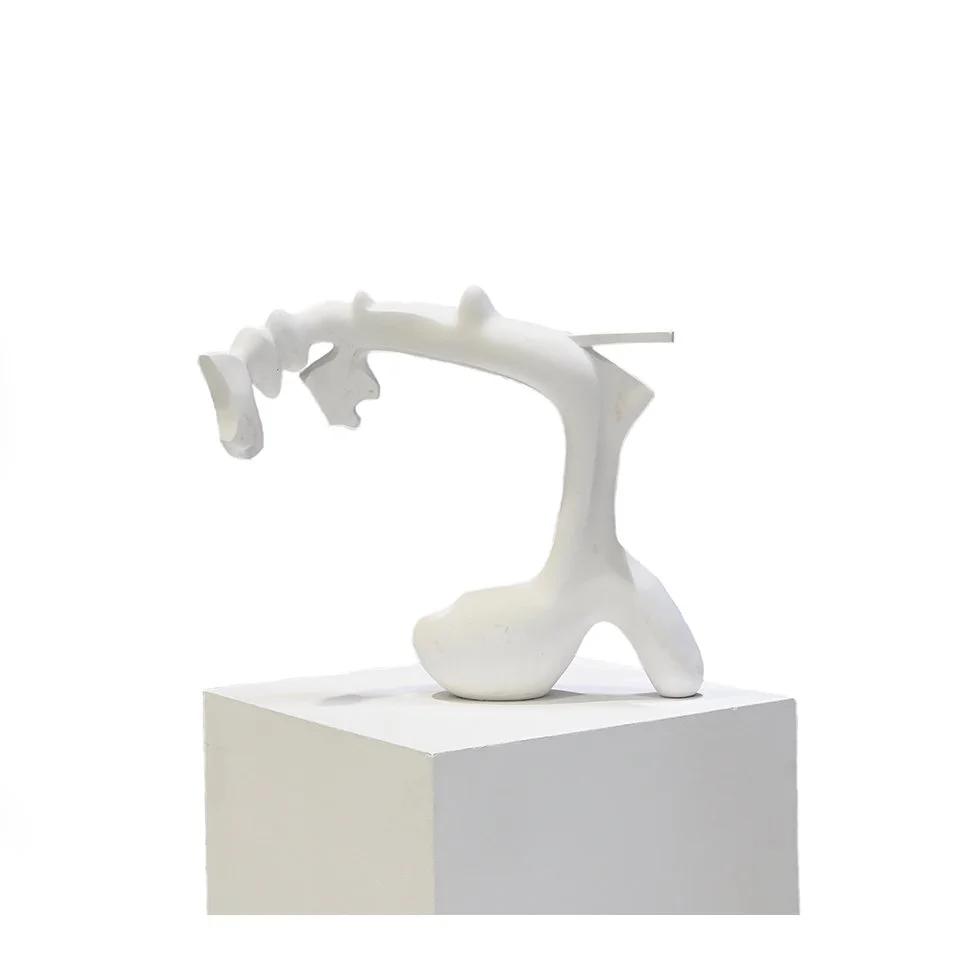
Identity Stretch, 2024, Plaster © Lydia Smith
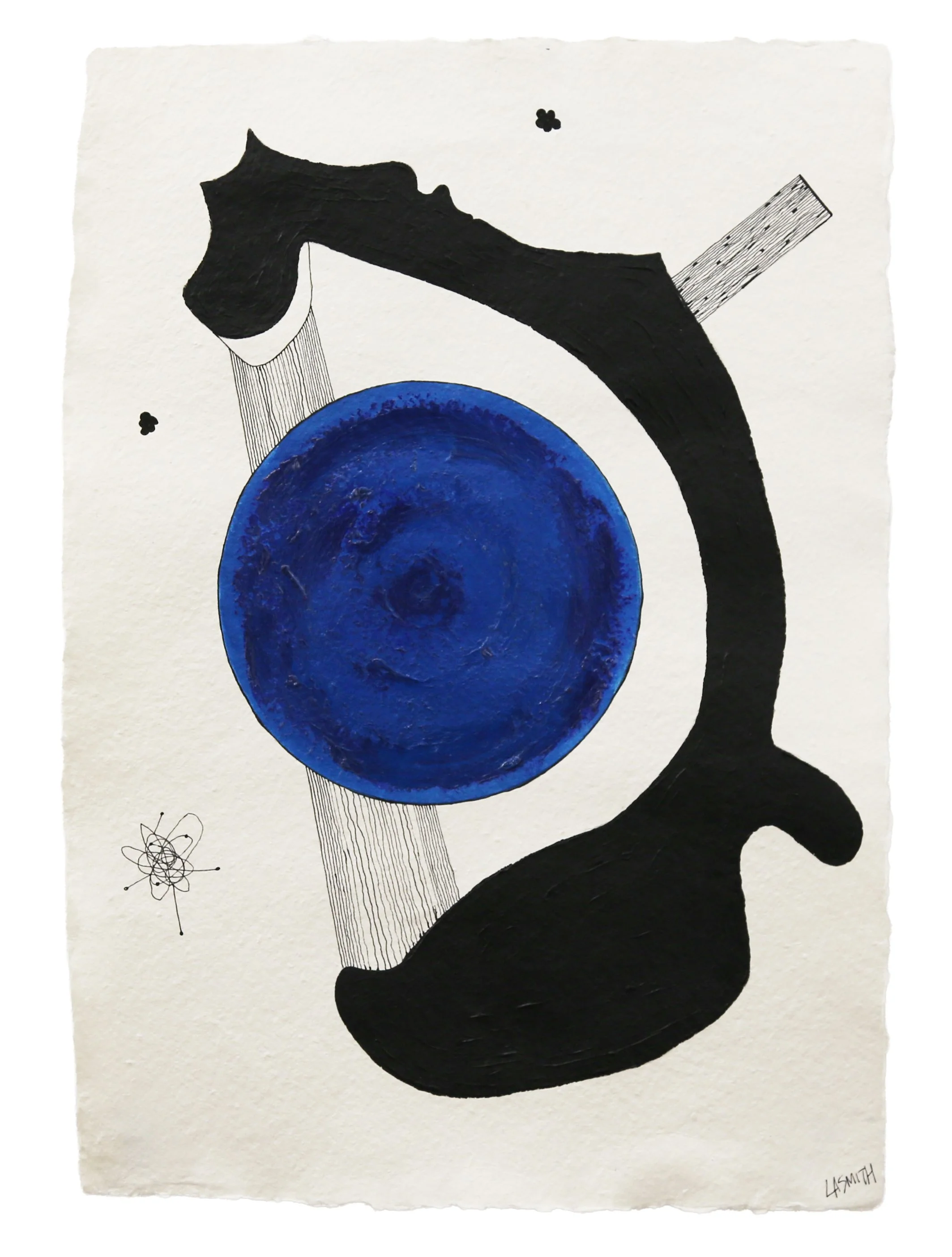
Innerworld, 2026, Acrylic, ink and laquer on 100% cotton paper © Lydia Smith
Lydia Smith’s works on paper emerge as extensions of her sculptural thinking, translating three-dimensional form into a two-dimensional space for continued exploration. Rather than functioning as preparatory studies, these works visualise how the sculptures continue to evolve within the artist’s mind. Forms appear suspended and weightless across the page, freed from gravity. Through drawing and painting, Smith reimagines sculptural configurations, allowing new forms and energies to surface beyond material limitation.
Within the configuration of the sculpture Identity Stretch, 2024, Smith envisions an electric blue orb suspended between the ‘head’ and ‘foot’, symbolising an energetic exchange and the completion of the sculpture’s internal loop. Rather than being materially realised, the orb exists as an immaterial presence, perceived more as energy or projection than as a physical object. The work on paper, Innerworld, 2026, becomes the site where this imagined presence takes shape. By translating form into two dimensions, she allows her visualisation to retain its imagined quality, preserving the sense of energy that a physical form might diminish.
Across her practice, Smith moves fluidly between sculpture, painting and digital processes, resisting fixed boundaries between mediums. Clay, plaster, bronze, scans, code and prints operate not as separate stages but as interconnected states within a continuous process of translation. Works on paper typically follow the creation of sculpture and are informed by mould making, digital “DNA blueprints” and the finished sculptures. For Smith they extend her inquiry, visualising elements that may be more fluid in two-dimensional space, revealing a practice that moves beyond material into multidimensional representations of form.
Read more about her process here